
The moment you exit the aircraft, everything changes.
Your body leaves solid ground, gravity takes over, the wind roars around you, and for a few unforgettable seconds, your brain tries to understand something wildly unnatural: you are falling through open sky.
But freefall is not just a thrill. It is physics in motion.
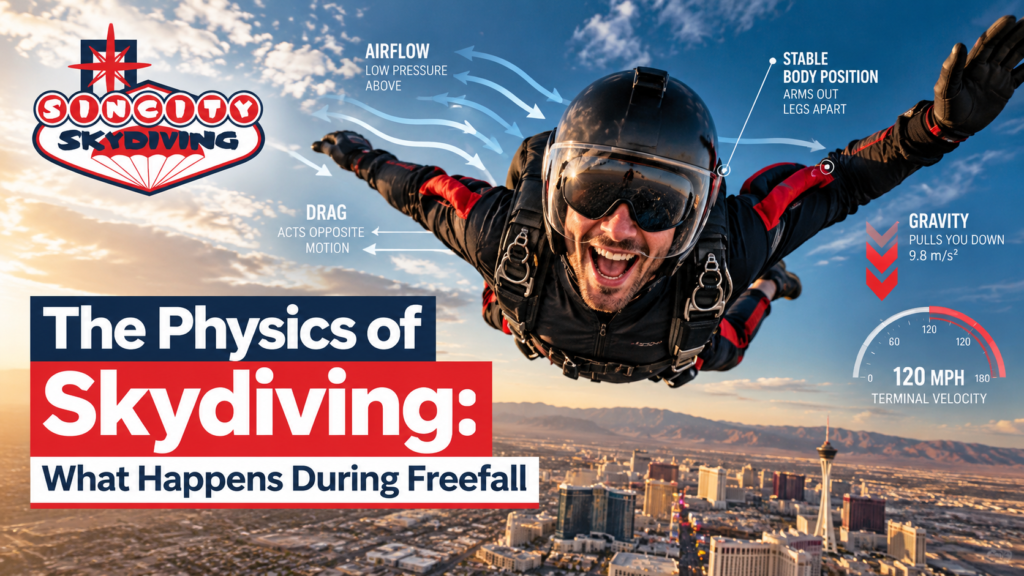
So, what happens during freefall? In simple terms, freefall in skydiving is the part of the jump where gravity pulls you downward before the parachute opens, while air resistance pushes back against your body. The balance between these forces controls your speed, body position, stability, and overall skydiving experience.
Let’s break down the skydiving science in a way that actually makes sense.
What Is Freefall in Skydiving?
Freefall is the phase of a skydive after leaving the aircraft and before parachute deployment. During this time, the skydiver is not floating. They are falling under the force of gravity while air resistance slows and stabilizes the descent.
In tandem skydiving freefall, the instructor and student are connected together using a specialized harness system. The instructor manages exit position, stability, altitude awareness, parachute deployment, and safety procedures.
Freefall usually feels less like “dropping” and more like being supported by powerful wind. That surprising feeling comes from air resistance.
How Freefall Works: The Two Main Forces
To understand how freefall works, you only need to know two main skydiving forces:
Force | What It Does | How It Affects Freefall |
Gravity | Pulls the skydiver downward | Creates acceleration after exit |
Air resistance | Pushes upward against the body | Slows acceleration and helps create stability |
At first, gravity is stronger than air resistance, so the skydiver accelerates. As speed increases, air resistance becomes stronger. Eventually, both forces balance out.
That balance is called terminal velocity.
Gravity and Skydiving: Why You Accelerate First
Gravity pulls every object toward Earth at about 9.8 meters per second squared before air resistance becomes significant.
In skydiving, this means your speed increases quickly right after exiting the plane. However, you do not keep accelerating forever. The faster you fall, the more air molecules your body hits.
That growing pressure from the air slows your acceleration.
This is why skydiving acceleration is strongest at the beginning of freefall and decreases as you approach terminal velocity.
What Is Terminal Velocity in Skydiving?
Terminal velocity in skydiving is the maximum falling speed reached when gravity and air resistance are balanced.
For a belly-to-earth skydiver, terminal velocity is commonly around 120 mph, though the exact speed depends on body position, weight, equipment, clothing, altitude, and air density.
A tandem pair may fall at a similar or slightly different speed depending on gear and drogue deployment. A drogue is a small stabilizing parachute used in tandem skydiving to control speed and improve stability.
Factors That Affect Skydiving Velocity
Your falling speed can change based on:
- Body position: A flat belly-to-earth position creates more drag.
- Surface area: More exposed surface area increases air resistance.
- Weight: Heavier objects can fall faster if drag is similar.
- Altitude: Thinner air at higher altitudes creates less resistance.
- Equipment: Tandem systems use specialized gear to regulate descent.
This is the heart of the aerodynamics of skydiving: your body becomes part of the flight system.
The Aerodynamics of Skydiving: Why Body Position Matters
Skydiving is not random falling. It is controlled movement through air.
Your body position changes how air flows around you. A stable belly-to-earth position spreads your arms and legs to increase drag, slow the fall, and create balance.
Think of your body like a human wing without lift-based flight. Small changes in arm, leg, hip, and shoulder position can influence direction, rotation, and stability.
Common Freefall Body Positions
Body Position | Effect |
Belly-to-earth | Stable, controlled, beginner-friendly |
Head-down | Faster, advanced discipline |
Tracking | Forward movement across the sky |
Sit-flying | Vertical freefly position, advanced |
For first-time jumpers, the instructor usually keeps the body position simple: hips forward, head up, arms relaxed, legs slightly bent.
Why Freefall Does Not Feel Like a Roller Coaster Drop
Many first-time jumpers expect that stomach-drop feeling. Surprisingly, most do not feel it the same way.
A roller coaster gives you sudden changes in support, direction, and acceleration. In skydiving, after the aircraft exit, acceleration smooths out quickly as air resistance builds.
Once terminal velocity is reached, the body is moving fast, but the speed feels steady. That is why many people describe freefall as floating on air rather than falling.
The wind is intense, but the sensation is often smoother than expected.
What Happens During a Tandem Skydiving Freefall?
During tandem skydiving freefall, the experience is managed step by step.
- Aircraft exit: You and the instructor leave the plane together.
- Initial acceleration: Gravity pulls you downward and speed builds.
- Stabilization: Body position and tandem equipment help control the fall.
- Terminal velocity: Air resistance balances gravity and speed levels out.
- Altitude awareness: The instructor monitors skydiving altitude carefully.
- Parachute deployment: The parachute opens, dramatically increasing drag.
- Canopy flight: Freefall ends and the descent becomes slower and controlled.
The biggest shift happens when the parachute deploys. Air resistance increases instantly because the parachute creates a much larger surface area. That turns a high-speed freefall into a controlled glide.
Skydiving Altitude and Freefall Time
Freefall time depends mainly on skydiving altitude and deployment altitude.
A higher exit altitude generally means a longer freefall. A lower exit altitude means less time before parachute deployment.
Typical recreational tandem jumps often exit from around 10,000 to 14,000 feet, depending on the drop zone, aircraft, location, and weather conditions. The freefall may last roughly 30 to 60 seconds.
That short window is packed with physics: acceleration, drag, stability, velocity, air pressure, and altitude management all happening at once.
Expert Tips for Understanding Your First Freefall
Before your first jump, knowing the science can make the experience feel less intimidating.
Practical Takeaways
- You are not “floating”; you are falling with controlled air resistance.
- Terminal velocity keeps your speed from increasing endlessly.
- Your body position helps create stability.
- The parachute works by dramatically increasing drag.
- Tandem instructors manage the technical parts so you can focus on the experience.
A smart first-time skydiving tip: do not fight the wind. Relax your body, listen during training, and let the instructor guide your position.
Why Skydiving Science Makes the Experience Safer
Skydiving education matters because the sport depends on predictable mechanics.
Modern skydiving uses physics, equipment design, altitude procedures, emergency systems, and instructor training to manage risk. The science behind the jump is not guesswork. It is based on repeatable principles:
- Gravity creates the fall.
- Drag controls the speed.
- Body position controls stability.
- Altitude determines timing.
- Parachute design controls landing descent.
The better you understand the mechanics, the less mysterious the experience feels.
Conclusion: Freefall Is Physics You Can Feel
Freefall is one of the clearest ways to experience physics with your whole body. Gravity starts the motion, air resistance shapes the fall, terminal velocity controls the speed, and aerodynamics help create stability.
For adventurers, understanding what happens during freefall adds a whole new layer to the skydiving experience. It is not just adrenaline. It is science, motion, trust, and control working together thousands of feet above the ground.
Before your first jump, learn the basics, choose a professional skydiving center, listen closely during training, and enjoy the rare chance to feel physics come alive in the open sky.
FAQ's
During freefall, gravity pulls the skydiver downward while air resistance pushes upward. The skydiver accelerates at first, then reaches terminal velocity when both forces balance.
No. You accelerate after exiting the aircraft, but as air resistance increases, acceleration slows. Once terminal velocity is reached, your speed becomes mostly steady.
Freefall feels like strong wind pressure against your body. Many first-time jumpers say it feels more like flying or floating on air than dropping straight down.
Skydiving velocity is controlled by gravity, air resistance, body position, equipment, altitude, and air density. Tandem skydiving systems also use specialized gear to regulate speed.
A parachute slows you down by creating a large surface area that catches air. This greatly increases drag and turns freefall into a slower, controlled descent.